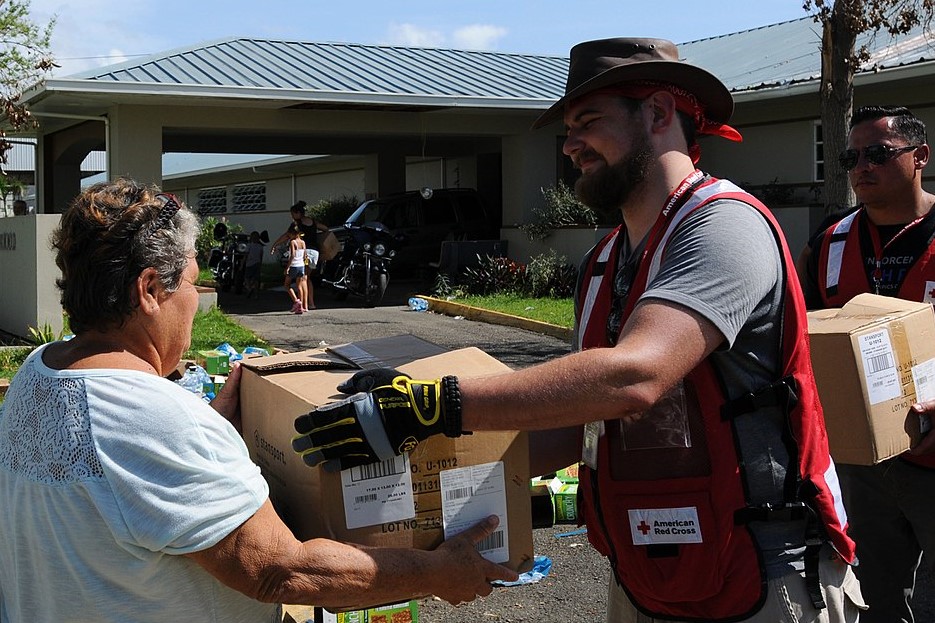
38th annual Governor’s Volunteer Awards nominations extended to July 23

Governor’s Volunteer Awards honor those who have made a difference through service across Texas

What

The nomination deadline for the 38th Annual Governor’s Volunteer Awards have been extended. Submissions will close Friday, July 23

The Governor’s Volunteer Awards are administered by OneStar Foundation and are an opportunity for the state of Texas to honor the exemplary service and volunteerism of individuals and organizations making a significant impact in communities across Texas.

Nominations for the awards are open in nine categories:

  • Governor’s Lifetime Volunteer Achievement Award 
  • First Lady’s Youth Volunteer Rising Star Award
  • Volunteer of the Year Award 
  • Volunteer Family of the Year Award
  • Corporate Volunteering Champion Award
  • Service-Learning Champion Award
  • Innovation in Volunteerism Award
  • Excellence in Disaster Volunteerism Award
  • National Service “Make a Difference” Award

This year, the Governor’s Volunteer Awards is introducing three new award categories:

  • Volunteer Family of the Year Award – Volunteering together as a family is a special experience that extends care from within the household out into the community. This new award category celebrates families that prioritize service as a core personal value.
  • Excellence in Disaster Volunteerism Award – As the most disaster-prone state in the nation, Texas relies on volunteers in all phases of disaster response and are key to creating sustainable and meaningful impact. Disaster volunteers deserve recognition for providing hope and stability in the midst of stressful and vulnerable circumstances and for ensuring our state is resilient to future disasters.
  • Innovation in Volunteerism Award – During the COVID-19 pandemic, nonprofits developed incredible innovations—including virtual service opportunities and heightened safety protocols—to ensure continued volunteer engagement and service delivery. Volunteerism is always evolving to the shifting needs of our communities, and this award category highlights organizations that excel in adapting to these demands. 

Who

The general public is asked to submit nominations for individuals and organizations who exemplify service and volunteerism that makes a significant impact in their local community across Texas.

Where

For descriptions of the award categories or to nominate an individual or organization, visit onestarfoundation.org/governors-volunteer-awards.

When

Nomination deadline is July 23, 2021

Awardees will be honored in the fall at an evening reception at the Governor’s Mansion hosted by Honorary Chair of the Governor’s Volunteer Awards, Texas First Lady Cecilia Abbott.

For more information visit onestarfoundation.org/governors-volunteer-awards.
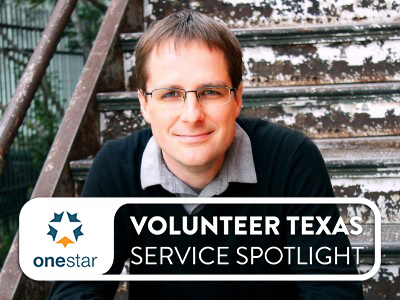
Good Samaritan pastor builds partnerships to help families on the road to self-sufficiency | Volunteer Texas Service Spotlight

Blake Jennings was a recipient of a 2020 Governor’s Volunteer Award. If you know an individual or organization making a significant impact in Texas communities through service and volunteering, you can nominate them for the 2021 Governor’s Volunteer Award here.

Pastor Blake Jennings noticed a need in 2015 when multiple single mothers in his College Station congregation came to him with vehicle problems. Blake and his wife Julie created a nonprofit called OnRamp that provides reliable transportation to people in need, setting them on the path to self-sufficiency and enabling them to care better for their families.

“We noticed that in the Brazos Valley, folks who lack reliable transportation end up struggling in a lot of ways. They have a difficult time getting and holding down employment. They have a difficult time getting themselves and their kids to education opportunities, to health care opportunities, to other services within the community. A lack of reliable transportation can be something that traps families in poverty for a long period of time,” Blake explained. “We saw that in our community and wanted to do something about it, so what OnRamp does is partner with other charities, school districts, healthcare providers, churches, and places of faith to identify individuals and families who are struggling towards self-sufficiency, but who lack reliable transportation, and we gift to them a reliable vehicle along with the first full year of repairs and maintenance.”

OnRamp’s impact has been substantial, donating 72 vehicles to date, and repairing approximately 30 more. OnRamp actively engages volunteers in both vehicle repair and client care and partners with more than two dozen local businesses and charitable organizations. Most recently, they gifted a single mother of four boys a Honda Odyssey minivan. One week later, one of her young sons was diagnosed with Type 1 diabetes, and the doctor’s immediate response was to send him to a specialist for treatment in Houston—an appointment that would have impossible to make without reliable transportation.

Blake spoke with OneStar about his volunteer journey and his motivations for serving others.

What inspires you to volunteer?

Being a pastor and coming from a faith-based background, so often we talk about the parable of the Good Samaritan, where you have a person coming to the aid of somebody who has been beaten and left for dead on the side of the road, or you have verses about somebody who has no food or clothing showing up to your door, and you help them. After preaching that for so many years, I realized no one is coming to my door and knocking on it, and I don’t drive down my neighborhood street and see a guy who has been beaten and abandoned. I know that happens in the world, but it is so easy to never see that in a suburban community in Texas. What motivated me was this feeling of I have to do something. There has to be people who are in that position. Maybe it’s not food that they need, but there have got to be some deep needs out there: people who have been abused or victimized that need help. I realized then that maybe the fact that I was an automotive engineer before I was a pastor wasn’t an accident—maybe there’s a reason that I have that background.

In our church, there was one single mom who brought me a car that she bought from a corner lot that was very shady. She had very limited funds and had poor credit rating, so she had to turn to a dealer who took incredible advantage of her. She has four kids, two of whom are struggling with disabilities, and she had no hope to get out of that. I realized that is my Good Samaritan moment: it’s through cars, and it is through helping people who been victimized or taken advantage of. This is my chance to live out the religion that I talk about. How do we put these beliefs into practice in suburban Texas? I think everybody has their particular gift that they are able to contribute to the community, and for me, it was through cars.

How do you build intentional community partnerships and inspire others to serve?

The primary way we rallied the community around the cause is to tell stories to make it tangible. Whether you’re talking about a person who might donate or a person who runs a business or a person who runs another charity that could partner with you, the human heart is driven by stories and by specific needs. It’s so easy for many of us to live our isolated lives in our suburban environment, but we don’t see the need. As long as we don’t see the need with our own eyes and it remains intangible, it is only an idea out there, and it’s very easy to ignore ideas. It’s very hard to ignore people and specific stories.

A big part of my role in leadership is to tell stories to people in ways that capture their hearts, so that they see how their unique set of skills and resources can make a tangible difference. I view myself as the networker. I’m the connector. When I’m speaking to people who are business owners in the automotive sector, a lot of them have a desire to contribute to their community, but how are they going to do that? I get to walk into your place of business and tell you a story that helps you to see how that radiator or that auto part that you’re going to offer us for a discount (or free) is going to make a tangible difference in the life of another person. If you can tell stories well in a way that resonates with the person’s heart and their skills and their resources, then people get excited. They’re enthusiastic because they wanted to make a difference and didn’t know how, so they jump up and want to get involved. The real work to be done is that inspiration that comes through telling stories, so people understand this is a tangible way in my community to make a measurable difference. That’s what leadership looks like for me.

What benefits has volunteer service had in your life?

Volunteering has given me an opportunity to put principles I believe into action. As long as we live a life where the principles we care about are never put into action, they never really transform us, and in a sense, we’re living a hypocritical and unfulfilling life. Finding an opportunity to take principles I believe deeply in and actually put them into practice allows me to see those principles become true and feel like my life is making a difference.

It has also been a source of a lot of hope. In the last four years, it just feels like there has been so much division and anger and disagreement in our world and in politics and in society that can be overwhelming, and it can induce anxiety and hopelessness and lead us to apathy. I find when I put away the news for a minute and go do this volunteering, it reminds me that there is hope. Even if I can’t fix things at a national level, for this lady that we gave a minivan to, what she cares about is that she can now take her son to get treatment for his condition. That’s what matters. It has given me great hope to feel like, in the midst of so much I can’t control, it’s okay because I have a place where I can actually contribute, and it makes a difference.

What advice would you give to someone to encourage them to volunteer?

What you will find is your hope and your peace in life will grow, and it will provide something for you that you can’t find anywhere else. For somebody who is asking, “Why should I volunteer?” I would ask, “How happy are you with your life right now? Do you feel completely fulfilled?”

Most people will say, “I feel anxious. I feel angry. I feel frustrated. I feel apathetic.” Whatever it is, there is a solution to all of that: go serve. If you go serve, you are benefiting the people you’re serving, but it is also benefiting you because it’s giving you hope, and it’s giving you meaning that will help counterbalance all of those things that worry you and frustrate you and anger you. It gives you a reason to wake up in the morning. It gives you a hope that your life is contributing in some meaningful way. I think that most people who are self-aware are going to realize that if they’re not volunteering, there’s something missing, and it’s leading to a life that is just a fraction of what it could be.

Volunteers sustain crime prevention nonprofit during a complicated year | Volunteer Texas Service Spotlight

Crime Stoppers of Houston was a recipient of a 2020 Governor’s Volunteer Award. If you know an individual or organization making a significant impact in Texas communities through service and volunteering, you can nominate them for the 2021 Governor’s Volunteer Award here.

The past year has been a challenging one for Crime Stoppers of Houston, which is leading Texas and the U.S. with innovative crime prevention programming to keep our communities safe. Established in the early 1980s as a Tip Line Program, Crime Stoppers is committed to solving and preventing crimes and now offers robust public safety and victim advocacy programs. Each year, the nonprofit reaches more than 5 million community members, educates over a million students, and provides crisis services and support to hundreds of victims and survivors. Through the power of volunteers, they also advocate for enhanced victim’s rights and public safety through peer support, legal advocacy, parole board hearings, support group meetings, and annual events.

“It was the most complicated year. I’ve never seen a year like 2020,” said Rania Mankarious, CEO of Crime Stoppers of Houston. “We started the year sounding the alarm on felony bond reform. We went straight from that into COVID and everything COVID meant for our kids in schools. We knew that family violence would go up, we knew animal abuse would go up, we knew child abuse would go up, we knew certain types of crimes would peak—especially around mental health and addiction. We went straight from navigating all of that into the killing of George Floyd that summer and everything that meant to the defund police movement.”

In the midst of these challenges, Rania said that volunteers have been “angels that are sent to keep nonprofits going with time, talent, treasures, in addition to research, outreach, and ideas.” Rania shared with OneStar the many ways that volunteers have made an impact in their organization.

What are innovative ways that Crime Stoppers of Houston has leveraged volunteers in the past year?

We are a small team. We have a staff of thirteen people that serve a city and county of 6 million people and ultimately reach the entire state of Texas and beyond. It was our volunteers that rose up. It was the board, it was our Young Professionals Group, it was our Leading Women for Public Safety, it was survivor leaders, it was experts in the field. They said, “We’re coming to the table. We’re going to join you in conversations. We’re going to join you in important questions. We’re going to join you in outreach, and we’re going to make sure that this message gets out.” When you think of all the issues that stemmed out of 2020, a lot of them involved information: information on COVID, information on crime, information on George Floyd, information on the relationship between police and communities. We needed help to get that information out.

We put together bits and pieces of this entire formula of women, young professionals, young kids, board members, business partners, community partners to create unique programming that was really specialized throughout the year. It’s just been incredible. The community and the volunteers have breathed life into so many of the programs we seek to push out every day.

What value do volunteers provide to your organization?

Our volunteers create a platform for us to increase our messaging. They provide research for us when we can’t research everything that’s coming in, and they give us ideas of new issues. They help us provide media stories when media needs our input but also want to hear from people in the community. If it wasn’t for our volunteers, there would be many communities in the Houston-Harris County area and across the state that we would not be able to reach. Our volunteers bring Crime Stoppers into corners and nooks of the city and county that there is literally no way for our team to reach. They’ve listened, they sit in on meetings, they help us craft messaging, they look at different demographics, and they fill in major gaps for us.

Following George Floyd’s killing, it was hard running a public safety nonprofit whose primary partner is law enforcement. We respect law enforcement with everything we have, yet we had to have very difficult conversations. There were volunteers within the law enforcement community that spent so much time with me. I’d say, “My gosh, I feel like some of these conversations are inherently disrespectful.” And they would say, “No, it’s OK to have these conversations, and here’s why: some of the history that is being brought up is fabricated but some of it’s not. Some of it is very deeply true—and we need to talk about it.” I spent so much time listening to volunteers within the law enforcement community, oftentimes being led literally to tears, but so thankful for their stories and for the fact that they said, “OK, so now what?” Now we continue to bridge the gap. We understand, so now let’s hold hands and come together. Those were some of the most moving, emotional, stretching, exhausting moments for me, and they will never, ever leave me. They were all at the hands of volunteers.

How does Crime Stoppers of Houston attract volunteers?

The key is making your mission relatable, and for most, that’s very easy to do. For us, it’s actually quite difficult. When you think of Crime Stoppers of Houston, the average person says, “That has nothing to do with me. I’m not going to be a tipster, and I’m not in an area where I’m watching crime. It doesn’t relate to me.” But we’re so much more than that Tip Line. Public safety is something every single one of us cares about. If you put a thousand people in the room, they will have a thousand different interests, hundreds of different languages, multiple different religions, orientations, dreams, and goals. But the thousand will agree that the health and the safety of themselves and their loved ones are among their top two or three concerns and priorities.

Public safety is something that we had to re-package: reminding people that we all care about it, that it is not a scary topic, and that actually it is quite empowering to understand how to take hold of public safety proactively. We don’t want to be reactive only after a crime is taken place. There are many things we can do right now to keep our kids safe, whether at school or online; to keep our business safe, no matter what climate we’re facing; to keep our neighborhoods and our home safe, our animals and the community safe, the elderly safe. There’s so much we can actively do.

How does Crime Stoppers of Houston retain its volunteers?

Keeping volunteers relies on making people feel valued. Volunteers don’t get paid for their time. Certainly it’s wonderful to put something like this on a resume, but that’s not enough to keep you coming back and volunteering at an event that helps us raise funds, or give out thousands of ID kits during a hot summer day, or research and share information that other people may not think is very popular. Volunteers have to feel appreciated. Once you’ve developed the connection and they understand the value of the message, they have to understand that we value them. It’s important to us that we constantly let them know. People want to get engaged and get their hands dirty, and it’s just wonderful for me to see huge groups—whether it’s individuals, corporate partners, or community groups—stopping and saying, “We’re going to do it. We’re going to use our employees and manpower to help you get a job done.”

Air Force veteran’s commitment to service extends beyond the military | Volunteer Texas Service Spotlight

Brandy Baxter was a recipient of a 2020 Governor’s Volunteer Award. If you know an individual or organization making a significant impact in Texas communities through service and volunteering, you can nominate them for the 2021 Governor’s Volunteer Award here.

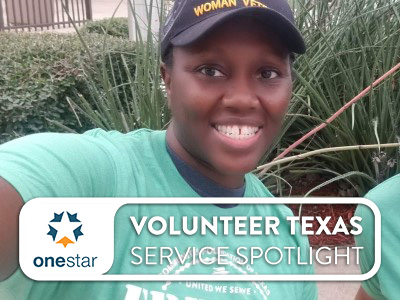
For U.S. Air Force veteran Brandy Baxter, serving others is a way of life that extends beyond her career in the military. She has found many ways to remain involved in her community, but her greatest calling has been in serving her fellow women veterans.

“We recognized that women veterans in the Dallas area were coming home and looking and finding resources, but they were not finding connection. The military is very much built around connection and camaraderie and working together, and if you didn’t need resources but you just wanted a new community, there were very few places to go,” Brandy said. “We came together and said, ‘Let’s build an organization that focuses on connection.’”

Brandy has collaborated with nearly every veteran organization in the Dallas-Fort Worth area to increase awareness about the unique needs of women veterans. She uses her professional experience in personal finance to host webinars and workshops for women veterans who may need assistance in managing their household income, and she has been a voice for women veterans as a frequent speaker on panels, podcasts, advocacy, and training events. Through her work with At Ease Texas, a nonprofit for women veterans by women veterans, Brandy was instrumental in bringing the Women Veteran Network program to Dallas and has created many networking opportunities for women veterans who want to connect with each other.

“My personal belief is a lot of the challenges that we are facing as a culture stem from self-centeredness versus other-centeredness,” said Brandy. “Volunteering allows you the opportunity to center someone else other than you. I think it’s healthy if we spend some time making others a priority. It influences our decisions because we’re more likely to make inclusive decisions when we have experiences from other people.”

Even when COVID-19 inhibited in-person events, Brandy continued to foster connection by serving on outdoor volunteer projects and hosting digital events in which participants wrote encouraging notes and assembled personalized care packages. As an added benefit, the online engagements allowed her to reach even more women veterans.  Brandy spoke with OneStar about how she cultivates a life of service.

How did you first get involved in service?

I always give credit to my grandparents. My grandfather had a garden in our backyard and would always share veggies with our neighbors. It felt like a community garden. My grandmother always had open arms: she would welcome anyone in the neighborhood to dinner. What I saw with my grandparents was this other-centeredness. It wasn’t about hoarding or being selfish—it was a very open environment. It impressed upon me to be grateful for what you have and to use what you have to help make someone else’s life better. We never know what that “better” is until we step into that space and offer what we can.

For me, volunteering started at a very early age. I remember in elementary school, I was a crossing guard. I have found myself involved because it is my way of impacting the world around me. It also comes out of a heart of gratitude for the little that I have—which still is a lot compared to someone who doesn’t even have that.

What motivates you to continue serving?

I’m inspired by a strong desire for change. Initially, volunteering for me was just a really neat way to give back. Now I feel volunteering is an opportunity to impact change. If something is bothering me—litter or trash, the way people are caring for their homes, or anything challenging in our society at large—I have found volunteering is a way to feel empowered to impact that change.

Here in our city, I volunteer on the local housing board, and it helps me to understand why affordable housing is important. I’m able to hear the stories firsthand of what people are experiencing. That shifts my perspective, so rather than pre-judging what I think is going on, I have a renewed respect for people who are living in tough situations. That’s one of the examples that keeps me going.

What benefit does volunteering provide to you?

Volunteering keeps me humble. My background is in personal finance, so I have seen both sides of the spectrum: clients who have affluence, and clients who have poverty. Volunteering helps me to never take anything for granted because you never know which end of the spectrum you’re going to be on with a turn of events.

Just think about COVID: all of those employees who could not go to work because their businesses or companies were cutting back. Those poor families were not expecting that. Volunteering reminds me to be grateful for all the things that you have because one decision can change the entire trajectory of your life. How do you want people to treat you? Do you want to be treated with respect and honor and recognition that you’re a human first? Every time I find myself in a situation where I’m able to provide for others, it just affirms for me that they are still people deserving of respect. Their circumstances are different, but you know what? Anything could change in your personal life that could also put you in a similar circumstance, so treat others the way you would want someone to treat you.

Why is it important for people to volunteer?

Volunteering is so much bigger than the task. It is so much broader than just picking up trash or reading to students or serving a meal. Really take the opportunity to allow volunteering to help you step into a world that someone else has to live in every single day. Hopefully that will influence the decisions that you make or the conversations that you have.

We often think of volunteering as homelessness or soup kitchens and shelters, but there are amazing organizations here locally and across the country that offer volunteering in so many areas. Whatever your area of interest is, I am certain you can find a way to volunteer. If you are troubled by something, I encourage you to volunteer so you can see the behind the scenes of what is going on in this situation. Volunteering gives you that insight.

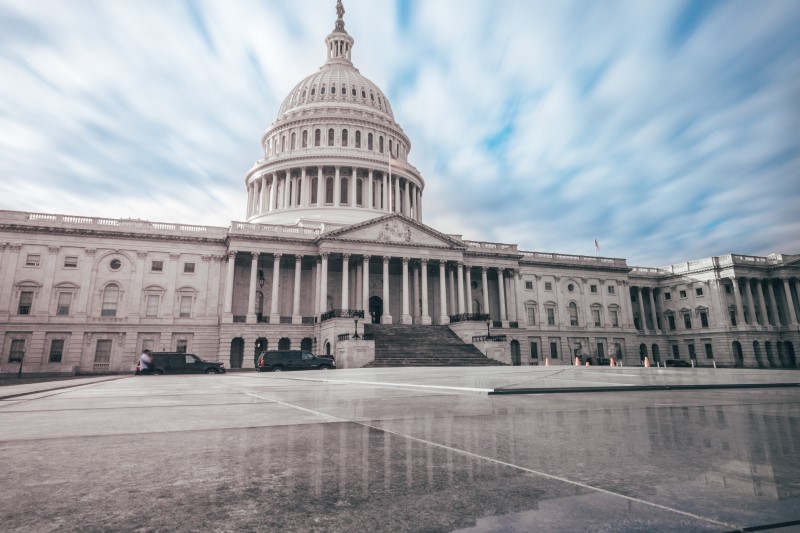
United States Capitol Building

AmeriCorps Legislative Updates

It is an exciting time for AmeriCorps! There have been several significant legislative updates with new bills, appropriations, and new partnerships to support and expand AmeriCorps. Below is a snapshot of the different items underway:

American Rescue Plan

The American Rescue Plan was signed into law on March 11, 2021. Included in this $1.9 trillion plan is $1 billion for AmeriCorps. The $1 billion is intended to increase the living allowance for AmeriCorps members, stabilize existing programs, and expand into new communities. Under this legislation:

  • The living allowance will increase to $16,000, an increase of $900 from the minimum amount posted in the Notice of Funding Opportunity.
  • The cost per MSY will increase from $16,300 to $20,000. These funds can be used to increase the living allowance further or provide necessary operating support to programs.
  • These funds will be available for the 2021-2022 program year.

FY22 President’s Budget

The Biden-Harris Administration submitted to Congress the President’s Budget for FY 2022, which includes strong support for AmeriCorps. The President’s Budget provides the following:

  • $1.2 billion for AmeriCorps, the agency (increase of $89.2 million over FY 2021 Enacted level).
  • $501 million to AmeriCorps State and National (increase of $46 million over FY 2021 Enacted level) that will support approximately 52,000 AmeriCorps members.
  • $103.86 million to AmeriCorps VISTA (increase of $6.5 million over FY 2021 Enacted level) that will support an estimated 8,000 full-time AmeriCorps members and summer associates.
  • Allow legal residents with Deferred Action of Childhood Arrivals (DACA) to serve in AmeriCorps and earn an education award.
  • Allow AmeriCorps VISTA members aged 55 and older to transfer education awards.

The CORPS Act

On April 15, 2021, Senators Chris Coons and Roger Wicker reintroduced the CORPS Act (Cultivating Opportunity and Recovery from the Pandemic through Service Act), Senate Bill 1165. They were also joined by a bipartisan list of co-sponsors in introducing the bill including: Sens. Baldwin (D-WI), Booker (D-NJ), Duckworth (D-IL), Durbin (D-IL), Kelly (D-AZ), Klobuchar (D-MN), Reed (D-RI), King (I-ME), Blunt (R-MO), Cassidy (R-LA), Collins (R-ME), Cornyn (R-TX), Graham (R-SC), Hyde-Smith (R-MS), and Rubio (R-FL). The CORPS Act proposes an $8 billion investment in national service programs, members, and state service commissions over a three-year period in order to contribute to our nation’s economic recovery from the COVID-19 pandemic. The House version of the bill is expected to be announced by the end of June.

Public Health Corps

On May 14, 2021, The White House announced $400 million for Public Health AmeriCorps. This new initiative is a partnership between the Center for Disease Control (CDC) and AmeriCorps. Public Health AmeriCorps will include a $400 million investment, over five years, from the CDC’s ARP funding that will enable the recruitment, training, and development of a new generation of public health leaders that are ready to respond to the public health needs of the nation by providing public health service in communities. The program will be part of AmeriCorps State and National, and engage between 3,500- 5,000 AmeriCorps members over five years.

Segal AmeriCorps Education Award Tax Relief Act

Senator Bill Cassidy (R-LA) joined Senator Michael Bennet (D-CO) and Reps. John Larson (D-CT) and Don Bacon (R-NE) as the lead sponsors of the new Segal AmeriCorps Education Award Tax Relief Act, which was introduced on June 16, 2021. This bill eliminates the tax on the education awards earned by AmeriCorps members for successfully completing their term of service.

Civilian Climate Corps

The Civilian Climate Corps (CCC) is a $10 billion investment to strengthen the country’s resiliency to climate change that has been included in the American Jobs Plan Act, as well as the President’s FY22 budget. AmeriCorps was not identified as a lead or partner agency on this initiative in either. Additionally, Senator Markey (D-MA) and Representative Ocasio-Cortez (D-NY 14) introduced the Civilian Climate Corps for Jobs and Justice Act, which did specify administration of this program by AmeriCorps. It is unclear if AmeriCorps would play a role in administering or partnering on a Civilian Climate Corps program, if enacted.

Five Lessons in Resilience from the Texas COVID Relief Fund

It has been more than a year since the Texas COVID Relief Fund was launched in May 2020, and we want to thank our partners for their commitment to building the resilience of Texas communities during this extraordinary time. Every dollar donated, every hour spent on a socially distanced video call, and every conversation about how we can help Texans recover have mattered greatly to our state.

Through the generosity of our donors, we were able to provide $955,350 in critical funding to 16 organizations, which in turn served nearly 475,000 individuals impacted by the COVID-19 pandemic. Over the course of the year, we met with each of these grantees to have insightful conversations about their needs and experiences, which we are excited to share in our Texas COVID Relief Fund Progress Report. As we discussed opportunities and lessons learned, here are five key themes that emerged, along with words directly from our grantees.

  • General operating funds provided nonprofits the flexibility to use funds as needs arose. Nonprofits appreciated the ability to increase staff size, build internal capacity through improved business processes, and pilot new service models to adapt to pandemic safety protocols. “We used flexible operational funding to investigate and identify operational efficiencies in the service model needed for long-term stability.”
  • Virtual programming increased the ability of nonprofits to reach larger, more diverse audiences. Funding allowed organizations to increase and diversify their pool of volunteers and new hires, shift organizational culture to include more diversity, equity, and inclusion practices, and move forward system-change goals. “We’ve identified a need to broaden our target audience by reaching new audiences where they are through outreach & engagement on platforms and at times most accessible to them.”
  • Volunteers stepped up to help their neighbors and community. Committed and adaptable volunteers were more important than ever to nonprofits facing increased community needs and limited staff capacity. In the face of distancing requirements, volunteers found safe and innovative ways to continue to provide support. “Although most of our volunteers are age 65 or over, a keenly vulnerable population during the pandemic, they continued to give their time and energy. That shows their passion and love for our mission.”
  • Partnerships between local community organizations increased. The pandemic created opportunities to build community cohesion and highlighted the importance of collaboration as multiple service providers linked up to meet increasingly complex and interconnected needs. “Coordinated efforts via partnership with local organizations allowed us to serve the whole family, rather than just children.”
  • Resilience and clarity of purpose kept leaders moving forward. Nonprofits were navigating the compounding stress of several unprecedented events at once as the COVID-19 pandemic and Winter Storm Uri destabilized communities. These concurrent events delayed timelines and required additional operational pivots in services, challenging leaders to stay focused and resourceful. “The Winter Storm required us to pivot drastically. We remained nimble, did not let policy paralyze us so we could continue to serve our mission, and used all the resources at our disposal—including staff who were eager to serve.”

We are grateful for the efforts of our partners who have served Texas communities diligently through the good and bad days of the pandemic. As vaccination uptake increases and some sense of “normalcy” returns, we acknowledge our unprecedented collective journey through moments of immense grief and suffering as well as triumph and hope, and we look forward to continuing to learn and grow through these shared experiences.

Please download our Texas COVID Relief Fund Progress Report for more information, and check out our current disaster response initiative, the Rebuild Texas Hurricane Season Recovery Fund.

Grant Announcement: $21.6 million awarded for AmeriCorps programs in Texas

OneStar announces $21.6 million in AmeriCorps funding for Texas

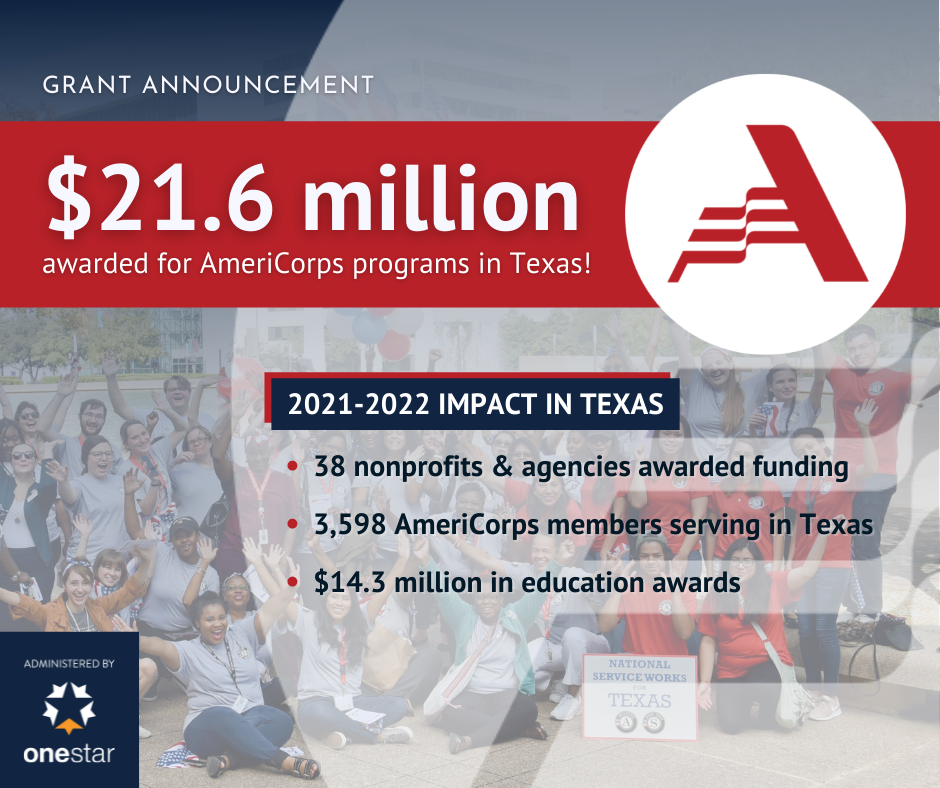
AUSTIN — OneStar today announced that Texas has received $21.6 million from AmeriCorps, the federal agency for national service and community volunteerism, to support 3,598 AmeriCorps members placed with 38 organizations throughout the state.

These AmeriCorps members will address some of the toughest social challenges in Texas by serving as tutors in low-income schools, providing college access services to first-generation college students, training adults in job readiness skills, distributing food to children and families in need, assisting with case management for the homeless, responding to Texas communities recovering from disaster, and much more.

This past year, AmeriCorps members were quick to adapt to meet the changing needs caused by the COVID-19 pandemic and developed new ways to deliver services while keeping both themselves and those they serve safe. AmeriCorps members in Texas have been active in hosting drive-through food and supply distributions, leading virtual education and enrichment activities to offset learning loss, and keeping vulnerable populations connected and engaged amidst social distancing requirements.

“Texans have endured many challenges this past year, and AmeriCorps members continue to play an essential role in helping communities recover and build resilience,” said Chris Bugbee, OneStar President & CEO. “AmeriCorps gives Texans the opportunity to put their values into action and make a difference while also developing civic and leadership skills to last a lifetime. I congratulate these outstanding organizations and thank all those who serve our Texas communities through AmeriCorps.”

The $21.6 million in funding, administered by OneStar, will be distributed to 38 organizations operating in Texas, including:

  • Access Health
  • Amarillo Independent School District
  • American YouthWorks
  • Austin Achieve Public Schools
  • Big Thought
  • BookSpring
  • Breakthrough
  • ChildFund International USA
  • City Year, Inc. (Dallas)
  • City Year, Inc. (San Antonio)
  • CitySquare
  • College Forward
  • Communities In Schools of Central Texas
  • Communities In Schools of North Texas
  • Communities In Schools of San Antonio
  • Equal Heart
  • Front Steps
  • Girl Scouts of Greater South Texas
  • Girl Scouts of Northeast Texas
  • Houston reVision
  • Imagine Art
  • Interfaith Ministries of Greater Houston
  • Legacy Community Health Services
  • Literacy Coalition of Central Texas
  • National College Advising Corps
  • Project Transformation
  • Reading Partners
  • Relay Graduate School of Education
  • Sewa International
  • Teach for America
  • Texas Department of State and Health Services
  • Texas Network of Youth Services
  • The University of Texas Rio Grande Valley
  • Travis County Health and Human Services
  • United Way of El Paso County
  • University of North Texas
  • UT Austin Charles A. Dana Center
  • West Texas A&M University

AmeriCorps will provide an additional $14.3 million in Segal AmeriCorps Education Awards for the AmeriCorps members in Texas funded by these grants. After completing a full term of service, AmeriCorps members receive an award of approximately $6,300 that they can use to pay for college or to pay off student loans.

The recently passed American Rescue Plan includes an additional $1 billion for AmeriCorps. The agency will use this investment to expand national service programs into new communities and increase the opportunity for all Americans to serve their country.

Every year, 75,000 AmeriCorps members serve through thousands of nonprofit, community and faith-based organizations across the country. These citizens have played a critical role in the recovery of communities affected by disasters and helped thousands of first-generation college students access higher education. They also tutor and mentor young people, connect veterans to jobs, care for seniors, reduce crime and revive cities, fight the opioid epidemic, and meet other critical needs.

As the federal agency for volunteering and service, AmeriCorps brings people together to tackle the country’s most pressing challenges. Since the agency’s inception in 1994, nearly 1.2 million AmeriCorps members have served the nation.

###

About OneStar
OneStar strengthens Texas communities by creating pathways for individuals and organizations to engage, connect and accelerate their impact. We advance service and volunteering as effective solutions to our state’s toughest social challenges. We are recognized as a statewide voice for the Texas nonprofit sector and a respected partner to foundations, state agencies and the business community. Born from state government in 1974, we carry out our mission with direction and guidance from the Office of the Texas Governor. Learn more at onestarfoundation.org.

Aerial satellite image of a hurricane.

OneStar launches Rebuild Texas Hurricane Season Recovery Fund to support resilience of Texas communities

New fund now accepting donations for disaster recovery in anticipation of active 2021 Atlantic hurricane season

AUSTIN — On the first day of the 2021 Atlantic hurricane season, OneStar announced the launch of the Rebuild Texas Hurricane Season Recovery Fund to support Texas communities affected by disaster.

“We know that living in Texas means that the next hurricane is not an ‘if’ but a ‘when.’ These storms disrupt the lives and livelihoods of millions of Texans each year with little warning,” said Chris Bugbee, OneStar President & CEO. “By proactively gathering and coordinating resources needed for recovery now, we can mitigate the devastating consequences of these disasters. Investing in the Hurricane Season Recovery Fund promotes the resilience of Texas communities and makes it easier for us to bounce back after a hurricane event.”

Researchers are forecasting above-average activity for this year’s Atlantic hurricane season, with predictions of up to 18 named storms, including as many as four major hurricanes of Category 3 or higher. At the same time, communities across Texas—still grappling with effects of the COVID-19 pandemic and Winter Storm Uri—are facing depleted resources as they brace for potential impacts of the hurricane season ahead.

The Hurricane Season Recovery Fund preemptively raises donations to ensure funding is readily available and can be quickly deployed in the aftermath of a major storm. This season, OneStar will work with state and local partners to assess the impact of weather events to Texas communities to ensure funding reaches organizations serving those most in need. 

Donations to the Fund will be directed to local organizations in communities affected by this hurricane season to ensure the immediate health and safety of Texans and to support short and longer-term recovery activities.

“The needs in the aftermath of a hurricane are tremendous, and it can take communities years to fully recover and rebuild after a major event,” said Michelle Brewer, OneStar board member and executive director of Hardin County Strong. “The Hurricane Season Recovery Fund gives us the opportunity to be strategic about how funding is distributed and adapt to fill critical gaps in the recovery effort.”

OneStar is currently accepting donations to the Hurricane Season Recovery Fund at onestarfoundation.org/hurricane-season-recovery-fund. Donations will be accepted year round.

###

About OneStar
OneStar strengthens Texas communities by creating pathways for individuals and organizations to engage, connect and accelerate their impact. We advance service and volunteering as effective solutions to our state’s toughest social challenges. We are recognized as a statewide voice for the Texas nonprofit sector and a respected partner to foundations, state agencies and the business community. Born from state government in 1974, we carry out our mission with direction and guidance from the Office of the Texas Governor. Learn more at onestarfoundation.org.

How to help Texas communities be #HurricaneStrong this hurricane season

The Atlantic hurricane season officially starts in June, and forecasters this year are expecting above-average activity and a high likelihood of a major storm impacting Texas. After an extraordinary 2020 season, which generated a record-breaking 30 named storms and 11 storms to make landfall on the U.S. mainland, Texans are on high alert. Meanwhile local communities—still grappling with effects of the COVID-19 pandemic and Winter Storm Uri—are facing depleted resources as they brace for potential impacts of the hurricane season ahead.

Every year, hurricanes wreak enormous havoc and trauma for Texans—upending millions of lives and livelihoods, disrupting economies, and causing billions of dollars in damage. But while these storms are inevitable, we can mitigate their consequences by proactively preparing, planning, and identifying resources before disaster strikes.

In anticipation of another busy year, OneStar launched the Rebuild Texas Hurricane Season Recovery Fund, which preemptively coordinates donations to ensure funding is readily available and can be quickly deployed in the aftermath of a storm. Giving to the fund is one way you can help Texas communities be more resilient in the wake of this season’s events.

Everyone has a role to play in helping Texas communities be #HurricaneStrong this season. In the words of community development and disaster recovery expert Angela Blanchard, “People can survive individually, but they thrive collectively.” In addition to donating to the Hurricane Season Recovery Fund, here are other actions you can take:

  • Stay aware.
    Follow state and local officials and organizations like the Texas Division of Emergency Management or National Weather Service West Gulf River Forecasting Center on their social media channels to remain aware of conditions throughout the hurricane season. Also research how your local city or county shares important updates. For example, Hardin County Strong is launching a free app that will keep users updated on county information, alerts, news, declarations and more. Residents will also be able to register for assistance or to become a volunteer.
  • Volunteer.
    Texans give thousands of hours of time and talent to provide critical voluntary support to local communities during all phases of the disaster. But to be most effective, we strongly recommend that you identify and sign up to volunteer with an organization before a hurricane strikes, so communities can move quickly to action. Check out the full list of Texas Voluntary Organizations Active in Disaster and sign up to help today, which ensures you will be vetted and trained to respond when you are called upon in a disaster.
  • Prepare your organization.
    Nonprofits across the state support Texans day in and day out, whether in blue skies or during a hurricane. If you are part of a nonprofit serving the community, take the American Red Cross Ready Rating three question “quiz” to assess your organization’s readiness, and explore the Ready.gov Hurricane Ready Business Toolkit for templates and tools to develop an emergency and continuity plan. You can also share resources to help your partners, customers, and clients stay aware and be prepared this season. Visit TexasReady.gov for resources you can share with fellow Texans.

Nominations now open for the 38th Annual Governor’s Volunteer Awards

A version of this press release was originally posted here by the Office of the Texas Governor.

Governor’s Volunteer Awards honor those who have made a difference through service across Texas

AUSTIN — Nominations are open for the 38th Annual Governor’s Volunteer Awards. The Governor’s Volunteer Awards are administered by OneStar Foundation and are an opportunity for the state of Texas to honor the exemplary service and volunteerism of individuals and organizations making a significant impact in communities across Texas.

“The resilient spirit Texans demonstrate day after day, year after year is alive and well,” said Texas First Lady Cecilia Abbott. “Time and again, Greg and I see the spirit of service across our great state. We are grateful for the many ways Texans care for and serve each other. The volunteer spirit that permeates the communities across our state is overwhelming. The Governor’s Volunteer Awards recognize the spirit and service of the Lone Star State.”

Nominations for the awards are open in nine categories:

  • Governor’s Lifetime Volunteer Achievement Award
  • First Lady’s Youth Volunteer Rising Star Award
  • Volunteer of the Year Award
  • Volunteer Family of the Year Award
  • Corporate Volunteering Champion Award
  • Service-Learning Champion Award
  • Innovation in Volunteerism Award
  • Excellence in Disaster Volunteerism Award
  • National Service “Make a Difference” Award

For descriptions of the award categories or to nominate an individual or organization, visit onestarfoundation.org/governors-volunteer-awards.

A list of last year’s 2020 Governor’s Volunteer Award winners can be found at onestarfoundation.org/first-lady-cecilia-abbott-onestar-foundation-announce-2020-governors-volunteer-awards-recipients. (Previous award winners may be available for media interviews upon request.)

“We are grateful to the Governor and First Lady for recognizing and celebrating the impact of volunteers in Texas,” said Chris Bugbee, OneStar CEO. “Each year we are inspired by the incredible acts of service from our Governor’s Volunteer Award winners.”

The past year has been a challenge for nonprofits engaging volunteers and has required extraordinary adaptability and innovation. OneStar surveyed Texas nonprofit organizations in late 2020 with a goal of better understanding how the COVID-19 pandemic has affected their work and missions (Texas Nonprofit Leaders’ COVID-19 Impact Report, December 2020). The survey showed that:

  • 42% of respondents faced increased demand for services from their clients and communities due to the COVID-19 pandemic.
  • 76% of respondents endured moderate to severe reductions in volunteer engagement for delivering their programs and services due to the COVID-19 pandemic.

“Though the last year has been unlike any other we have known, volunteers have demonstrated incredible resilience and remained committed to giving their time and talent to support communities across Texas,” Bugbee said. “We all recognize the heightened needs and challenges the pandemic has brought. We look forward to recognizing those who continued serving others and provided light in what has been a dark time for so many.”

This year, the Governor’s Volunteer Awards is introducing three new award categories:

  • Volunteer Family of the Year Award
    Volunteering together as a family is a special experience that extends care from within the household out into the community. This new award category celebrates families that prioritize service as a core personal value.
  • Excellence in Disaster Volunteerism Award
    As the most disaster-prone state in the nation, Texas relies on volunteers in all phases of disaster response and are key to creating sustainable and meaningful impact. Disaster volunteers deserve recognition for providing hope and stability in the midst of stressful and vulnerable circumstances and for ensuring our state is resilient to future disasters.
  • Innovation in Volunteerism Award
    During the COVID-19 pandemic, nonprofits developed incredible innovations—including virtual service opportunities and heightened safety protocols—to ensure continued volunteer engagement and service delivery. Volunteerism is always evolving to the shifting needs of our communities, and this award category highlights organizations that excel in adapting to these demands.

Nominations will close July 16, 2021. Awardees will be honored in the fall at an evening reception at the Governor’s Mansion hosted by Honorary Chair of the Governor’s Volunteer Awards, Texas First Lady Cecilia Abbott. For more information visit onestarfoundation.org/governors-volunteer-awards.

###

About OneStar
OneStar strengthens Texas communities by creating pathways for individuals and organizations to engage, connect and accelerate their impact. We advance service and volunteering as effective solutions to our state’s toughest social challenges. We are recognized as a statewide voice for the Texas nonprofit sector and a respected partner to foundations, state agencies and the business community. Born from state government in 1974, we carry out our mission with direction and guidance from the Office of the Texas Governor. Learn more at onestarfoundation.org.