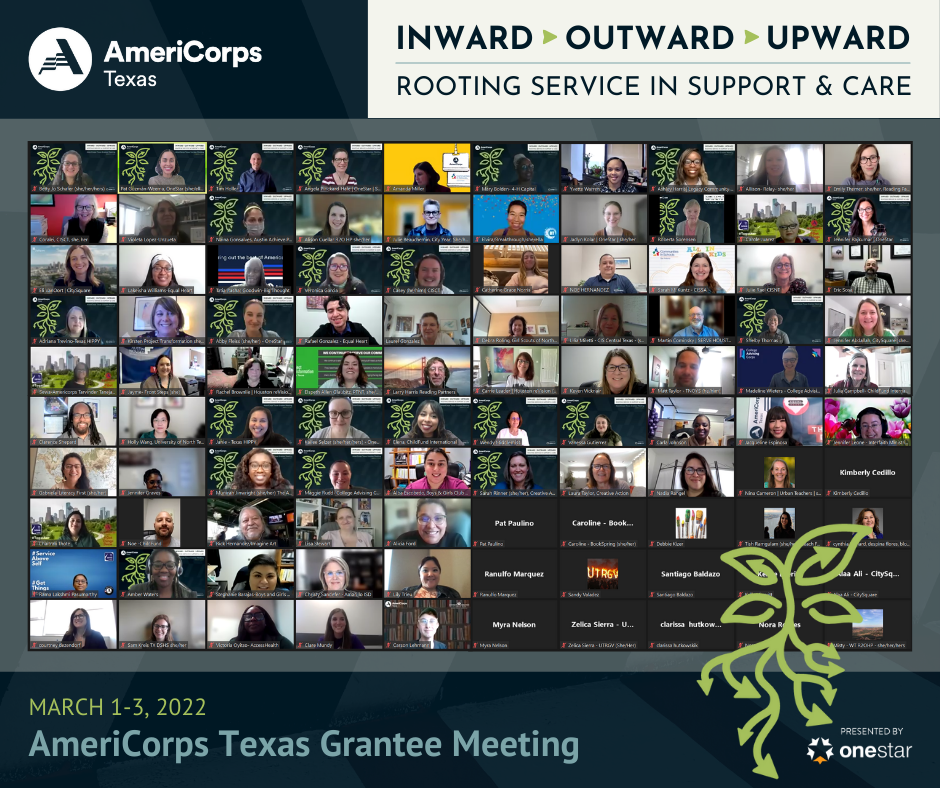
AmeriCorps Texas Grantee Meeting | March 1-3, 2022 | Inward > Outward > Upward: Rooting Service in Support & Care

Inward > Outward > Upward | 2022 AmeriCorps Texas Grantee Meeting

As we strive toward progress, in which direction are we focusing our energies? Hosted March 1-3, the 2022 AmeriCorps Texas Grantee Meeting featured the theme of Inward > Outward > Upward, which recognizes that our service must be rooted in support and care. We can make the greatest impact by first looking inward to address issues like burnout and belonging. Affirming our own humanity helps us better understand and serve others—and ultimately elevates all Texas communities.

During these extraordinary and often overwhelming times, the 2022 AmeriCorps Texas Grantee Meeting equipped AmeriCorps program staff with strategies to support mental health and personal development, while continuing to provide training and best practices for effective program management.

Here are a few memorable highlights from this year’s AmeriCorps Texas Grantee Meeting:

  • Emphasis on mental health and self-care. Our AmeriCorps Texas programs have been through a lot in the past year, and we wanted to acknowledge the toll serving on the front lines of complex social issues can have. During our keynote session, we were inspired by Nicole Smith from Game Day Prep 365, who offered strategies for self-care and building a strong foundation that allows us to better serve others. Grantees came away with practical recommendations, such as making self-care non-negotiable, setting boundaries, leaning on our networks, and taking that energy to elevate other. We also engaged workplace wellness experts from AllOne Health to conduct workshops on managing “compassion fatigue” and building a positive team atmosphere. Presenters from The SISGI Group provided rich insight into how to build psychologically safe and inclusive spaces.
  • Adapting to COVID-19 pandemic. The COVID-19 pandemic has fundamentally altered how we approach our work, and we wanted to hear directly from our AmeriCorps Texas programs how they have pivoted in their approach to service and member management. AmeriCorps Texas programs Literacy First and College Forward shared innovative ways they have adapted their service models, including engaging returning members, recruiting from the local community, adapting member slot types, and creating new staff positions to improve the member experience. In addition, Equal Heart and Communities in Schools of Central Texas opened up in an honest discussion about the stresses of managing an AmeriCorps program and shared brilliant strategies for supporting members, from proactive rapport building to ideas for constructive corrective action.
  • Integrating Diversity, Equity & Inclusion. Centering Diversity, Equity & Inclusion is an essential skill for running an effective AmeriCorps program. To ensure we integrate these ideals into every aspect of our work, we hosted a Leadership Lab that sparked DEI discussions at an executive level, while also offering a workshop on cultural humility & intersectionality with practical applications on how to help front-line AmeriCorps members develop a lens of empathy and understanding. For our closing session, Dr. Thenara Bailey of The SISGI Group challenged all of our AmeriCorps Texas programs to create an authentic culture of inclusivity by Bringing Everything, Living Openly, and committing to Nonstop Growth (BELONG!).
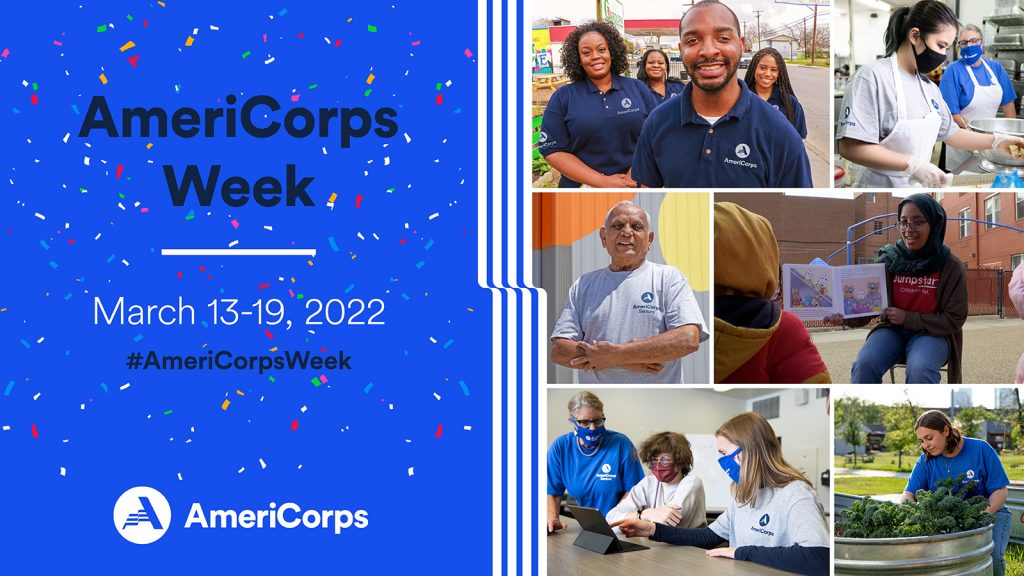
AmeriCorps Week | March 13-19, 2022 #AmeriCorpsWeek

Get ready for AmeriCorps Week 2022

Every March, we celebrate AmeriCorps Week. This year we’re celebrating March 13-19.

During AmeriCorps Week, we recognize the commitment of the millions of individuals who have chosen to serve Texas communities through AmeriCorps and encourage more Americans to follow in their footsteps of service.

We are thankful for all the hard work by so many and are confident national service is ready to meet the moment and continue to help make an impact.

Looking for ways to participate?

  • Share videos, photos, and posts on social media offering #AmeriThanks to AmeriCorps members and alums throughout the month of March. Check out the AmeriCorps Week social press kit for sample posts and key messages. Remember to tag or mention OneStar on Instagram, Facebook, Twitter, and LinkedIn, so we can amplify your message!
  • Host a virtual thank you celebration or reach out directly to AmeriCorps members or alumni.
  • Nominate a member or alumnus for a service award, such as the Harris Wofford Joint Service Award or the Presidential Volunteer Service Award.
  • Join us on the Day of the A. Don your best gear, very large pin, baseball cap, stickers, take a photo, and share it on your personal social media channels on Thursday, March 17, in honor of the Day of the A. AmeriCorps alumni are invited to share pictures and videos from their service.
  • Help declare March 13-19 AmeriCorps Week in your community by securing AmeriCorps Week proclamations from your city council or county commissioners. Download a proclamation template here, and contact OneStar to get AmeriCorps statistics specific to your city or region.
  • Send the AmeriCorps Week social press kit to local elected officials and community leaders and encourage them to recognize AmeriCorps Week on social media.
  • Host an “honorary AmeriCorps member.” Invite an elected official, community leader, school principal, or other local dignitary to see your program in action by becoming an “honorary AmeriCorps member” or by doing a site visit.

This AmeriCorps Week, join with us as we celebrate the impact of our programs and offer our thanks to members and volunteers for making an impact and serve others. Make sure you stay up to date and follow along on AmeriCorps’ Instagram, Facebook, Twitter, and LinkedIn for the latest on AmeriCorps Week.

Together, we can help the country recover and come back stronger. Together, we persevere. Together, we are AmeriCorps.

Words Matter, Actions Matter. Serve on MLK Day 2022.

The 2022 MLK Day of Service is almost here – and Texans across the state are rolling up their sleeves in service. Are you ready to get out and serve?

The Martin Luther King Jr. Day of Service is a defining moment each year when Americans across the country step up to make our communities more equitable and take action to create the Beloved Community of Dr. King’s dream. While Dr. King believed The Beloved Community was possible, he acknowledged and fought for systemic change. His example is our call to action.

Making time to volunteer for MLK Day of Service is a great way to engage with your community while honoring the legacy of Dr. King. Whether you plan on cleaning up a public space, mentoring a young person or engaging dialogue to explore ways to address inequity, foster inclusion and improve access, honor Dr. King’s legacy through service.

Looking for a way to participate?

While much work remains to fulfill Dr. King’s dream of a Beloved Community, service can help unify Americans of different backgrounds and experiences. Through service we can build more equitable and just communities to underpin racial equity, expand civic opportunities, and foster respect for individual differences.

How will you step forward and serve this MLK Day?

Three Powerful Examples of Government & Nonprofit Collaboration in 2021

The Interagency Coordinating Group highlights effective models and best practices for government & nonprofit collaboration. By working together, we can share resources, build capacity for organizations, and increase overall support for the nonprofit sector in Texas. Maintaining open communication and a strong network is critical to achieving the goal of the ICG – to build a strong public sector that ensures social services and resources are reaching Texas communities.

In 2021, the ICG highlighted best practices in collaboration with faith-based and community organizations to ensure a coordinated and widespread response to the COVID-19 pandemic. Here are three Texas state agencies that took unique approaches to working with fellow public sector organizations to extend their impact.

  • Texas Division of Emergency Management (TDEM) excels at building bridges for organizations and providing information and resources to community members. As capacity boosters, TDEM recognizes each organization has its own mission and conducts outreach to consider all perspectives when responding to emergency situations. One of the ways TDEM accomplishes this is by engaging Voluntary Organizations in Disaster (VOAD), a network of faith-based and community organizations that have made disaster work a priority. When a disaster happens, they support VOADs in understanding the needs and facilitate partnership with local organizations to discuss the availability of vital resources. As a result, TDEM brings diverse efforts together and fosters conversations on how the network can collectively serve Texans.
  • The Texas Department of State Health Services (DSHS) works with Texas faith-based and community organizations to promote vaccination in local communities. DSHS operates the Texas Vaccine Outreach and Education Grant Program, which addresses vaccine hesitancy in communities. Community organizations were awarded funds to engage their community in COVID-19 vaccine education and other activities to increase the number of vaccinated Texans. The program advises organizations with strategies to increase knowledge of and access to COVID-19 vaccines for those who have been disproportionality affected by COVID-19. DSHS relies on the community expertise of these nonprofits to build stakeholder buy-in within individual communities to best address Texans’ needs.
  • The Texas Department of Family Services (DFPS) partners with the faith community, foundations, advocates, and volunteers to improve service delivery for children, families, and adults. The agency has partnered with CarePortal, an interdenominational network of churches that collaborate for the benefit of children and families in their communities. Through the online platform, caseworkers identify needs and submit them through careportal.org, which enables greater reach to local faith communities equipped to fulfill the requests. To date, resources through the CarePortal have helped serve more than 16,000 children across 51 counties Texas, with an estimated economic impact of $4.4 million. During the COVID-19 pandemic, the platform was expanded include to families in Adult Protective Services to ensure that needs are being met for all Texans.

For more examples of how nonprofit organizations and government collaborate, check out the latest 2021 Interagency Coordinating Group legislative report linked here.

Joshua WinataDinorah Lopez
Program Specialist, Nonprofit Strong

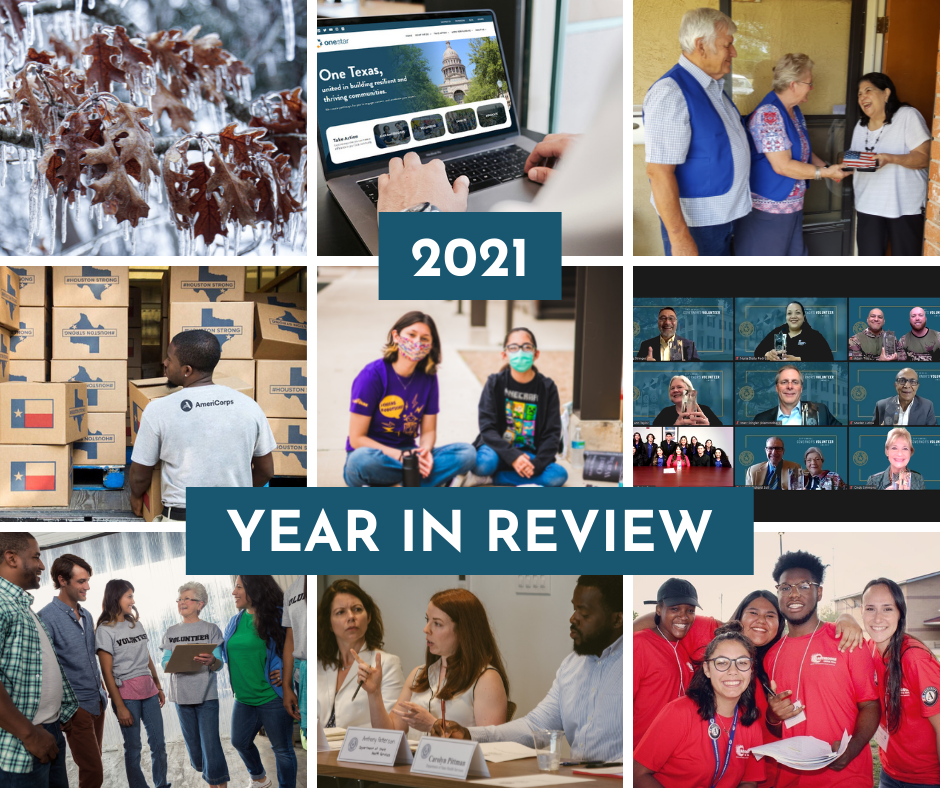
2021 Year in Review

Year in Review: 10 Highlights from 2021

As we approach the year’s end, we are looking back at achievements and challenges overcome in 2021. Here are 10 highlights that made an impact on our work in the past year:

No. 10: Responding to Winter Storm Uri

In February, Texans collectively endured the deep freeze of Winter Storm Uri, which left millions without basic utilities and resulted in the devastating loss of life and property. But amidst the turmoil and lack of infrastructure, grassroots efforts of neighbors helping neighbors emerged throughout the state that truly demonstrated the resilience and generosity of Texans. Recognizing the power of hyperlocal efforts, we made it our goal to amplify these organizations and groups and direct attention and funding to those on the front lines who were best attuned to community needs.

No. 9: Launching the new OneStar website

OneStar launched a new website in March to reflect our revitalized purpose and programs. Intended as a hub for taking action and securing resources, the platform is mobile-responsive and reflects the many ways that Texans can engage in their communities by joining AmeriCorps, volunteering, advocating for the nonprofit sector, donating to vulnerable communities, and more. We were also able to more prominently feature the work of our partners with grantee directories and encourage storytelling and insight sharing on our blog.

No. 8: Launching VolunteerTX

In commemoration of National Volunteer Month in April, we launched VolunteerTX, an online volunteer connector platform that aggregates service opportunities statewide. This digital hub relies on the partnership of volunteer centers around the state to create infrastructure on a regional scale and gives Texans an accessible starting point to take action. VolunteerTX provides an interactive foundation upon which we can build future campaigns to promote volunteerism statewide in the months ahead.

No. 7: Expanding AmeriCorps in Texas

In June, AmeriCorps announced that it would be directing $1 billion American Rescue Plan resources to address the ongoing challenges from the COVID-19 pandemic. In response to this exciting expansion, OneStar opened two notices of funding this fall to give Texas nonprofits and organizations access to these valuable national service resources and encourage the development of AmeriCorps programs as an effective solution to the complex issues facing our communities. 

No. 6: Reaching Rebuild Texas Fund milestones

Throughout the summer and fall, we distributed the remaining funds from the Rebuild Texas Fund to support recovery efforts addressing the COVID-19 pandemic and Hurricane Harvey. We recognize that these disasters have persistent effects well beyond the immediate relief response, and communities need sustainable funding for long-term projects to truly build resilience. In total, OneStar granted nearly $1 million raised via community donations to address the consequences of COVID-19 and collaborated with the Michael & Susan Dell Foundation to distribute $100 million over four years for Hurricane Harvey recovery efforts.

No. 5: Evolving the Governor’s Volunteer Awards

In October, we celebrated the 38th Annual Governor’s Volunteer Awards, recognizing individuals and organizations that have made an impact on Texas communities through exemplary service & volunteering. This year, we restructured and added new categories一including Excellence in Disaster Volunteerism, Innovation in Volunteerism, and Volunteer Family of the Year一to reflect the new trends and realities in volunteer service. Following public health recommendations, we honored our winners via an online awards reception and got to virtually meet all of the distinguished award recipients.

No. 4: Promoting volunteerism with Volunteer Generation Fund grant

This summer, OneStar was awarded more than a quarter million dollars through AmeriCorps’ Volunteer Generation Fund to strengthen the volunteer infrastructure in Texas and make volunteerism more accessible statewide. These resources are being put to work to create pathways for engaging all those who answer the call to serve. Over the coming months, we will be creating opportunities to convene volunteer leaders in Texas, offer training and support to organizations that work with volunteers, and promote volunteer postings statewide.

No. 3: Announcing new appointees on the Texas Nonprofit Council

In October, Texas Governor appointed 11 new members to the Texas Nonprofit Council, which was created to strengthen relationships between state government and the nonprofit sector. In the years ahead, these leaders will work to develop recommendations & best practices for collaboration between government and faith-based & community organizations and will identify and address gaps or duplication in services to the community. This group is an important partner to the Interagency Coordinating Group and will provide front-line insight and perspective to participating state agencies.

No. 2: Advancing AmeriCorps with the National Service Challenge Grant

OneStar was awarded a National Service Challenge grant from the Schultz Family Foundation to promote national service as a pathway of opportunity for young people. This million-dollar initiative recognizes AmeriCorps as an effective solution to building resilient & thriving communities and invests in ways to engage even more individuals in service. With this grant, OneStar will be partnering with AmeriCorps Central Texas to scale effective member recruitment practices across Texas while continuing to support their innovative approaches to place-based recruitment. In addition, OneStar will be investing in professional development resources and training for AmeriCorps members statewide focused on supporting their post-service career path.

No. 1: Growing the OneStar team

A lot of new faces joined OneStar this year as we ramped up capacity to support the growing AmeriCorps Texas portfolio and dedicated staff resources to our Volunteer Texas, Disaster Resilience, and Nonprofit Strong programs. We welcomed the fresh perspectives and very impressive skillsets that these staff additions bring to our mission. and we are excited to have the expertise and experience on our team to better support Texas nonprofits and communities. We invite you to meet the team and to reach out to learn more about how you can partner with OneStar in the year ahead!

Schultz Family Foundation Launches $1 Million National Service Challenge to Support National Service as a Pathway of Opportunity for Young People

This press release was originally posted here by the Schultz Family Foundation.

SEATTLE — The Schultz Family Foundation, founded by Sheri Schultz and former Starbucks CEO and Chairman Emeritus Howard Schultz, today announced recipients of its National Service Challenge to support national service as a pathway of opportunity for young people, especially people of color and young adults from low-income households.

Recognizing the role of philanthropy as an innovation partner to the public sector, the Foundation launched the National Service Challenge in May 2021 to offer matching grants of $100,000 to $250,000 to state service commissions partnering with philanthropy to increase diversity of AmeriCorps, to make service a pathway of opportunity for all young people, and to offer support and mentorship during and after their service. As a result of the Challenge, the Schultz Family Foundation is investing $3.5 million in seven U.S. states: Iowa, Michigan, Minnesota, Pennsylvania, South Carolina, Texas, and Washington. The Foundation’s investments will be supplemented by $5.1 million in matching grants from other philanthropic partners, which the Challenge helped to unlock.

The Challenge builds upon the Foundation’s learnings and impact over the past year in developing the Washington COVID Response Corps, a first-of-its-kind youth service program created in partnership with Serve Washington to respond to record levels of community need resulting from the COVID-19 crisis while expanding meaningful opportunities to young people whose lives were disrupted by the pandemic. In its second year, the program is being expanded to address community needs in addition to food insecurity such as mental health, workforce development, and mentoring for middle school students in support of foster youth.

Challenge grants will support the seven states in the following ways:

  • Iowa: Volunteer Iowa and its key partner, Refugee RISE AmeriCorps, will pursue a set of initiatives designed to make Iowa AmeriCorps programs more accessible to those from low socioeconomic status, increase member professional development, make Iowa service sites more welcoming of members from diverse backgrounds, and prepare more BIPOC-led and rural non-profits to engage with national service.
  • Michigan: Michigan Community Service Commission (MCSC) will focus the core of its work on increasing the recruitment and retention of youth AmeriCorps members of color. MCSC will pilot a pre-service basic needs assessment with incoming members to identify barriers to successfully completing a service year. Individuals with identified barriers will receive financial support and connection with community organizations to mitigate challenges.
  • Minnesota: In addition to establishing an emergency assistance fund for AmeriCorps members across the state, ServeMinnesota will pilot the Pathways to Economic Inclusion Through AmeriCorps initiative, which will provide 20 AmeriCorps members with the opportunity to earn an Associate in Arts (AA) degree tuition-free; an increased living stipend; assistance from a resource navigation specialist; professional development opportunities; and a “last dollar” fund to cover additional or unforeseen costs associated with earning their AA degree.
  • Pennsylvania: PennSERVE will take a multi-pronged approach to increasing recruitment, retention, and outcomes for BIPOC and/or low-income youth AmeriCorps members by: 1) piloting a cross-program initiative and shared on-the-ground recruiter to build a service to city government career pathway; 2) launching an emergency assistance fund; and 3) creating a learning community among programs to share innovations and work around increasing diversity and equity.
  • South Carolina: The South Carolina Service Commission will build on its multifaceted strategy to expand service and advance equity within the state by focusing on recruitment and retention. The Commission will work alongside Historically Black Colleges and Universities (HBCUs), service clubs, and other key community leaders to raise awareness of available service opportunities through AmeriCorps, focusing specifically on recruiting and enrolling youth and young men of color. To better support AmeriCorps Members during their year of service, the Commission will expand its emergency assistance fund, which was piloted in 2020. In the pilot year 100% of AmeriCorps Members who benefitted from the fund graduated from their service terms rather than having to make a difficult financial decision to withdraw from their term of service to afford the cost of an emergent need.
  • Texas: OneStar Foundation (a.k.a. Texas State Service Commission) will build on work piloted by AmeriCorps Central Texas (ACT), a unique collaborative of nine AmeriCorps grantees that came together to develop new recruitment strategies focused on engaging young people within their local communities to serve. OneStar Foundation will take the effective practices identified by ACT and scale the strategies statewide while continuing to support ACT’s innovative approach to place-based recruitment. In addition, OneStar will be investing in professional development resources and trainings for AmeriCorps members statewide focused on supporting their post-service career path.
  • Washington: Through a partnership with Serve Washington, the Foundation will fund a second year of the Washington Covid Response Corps, expanding the focus of the corps beyond food insecurity to additional community needs such as mental health, economic development, and learning loss among elementary school students. The Response Corps will also continue its work in developing national service as a pathway to opportunity for all young people in Washington state through additional member development training focused on supporting each member’s post-service career path and providing training that results in the form of an earned credential.

All seven states will participate in a learning collaborative facilitated by America’s Service Commissions to share insights and best practices, which will result in research that will be shared with every state service commission across the country.

— 30 —

About the Schultz Family Foundation
The Schultz Family Foundation, established in 1996 by Sheri and Howard Schultz, former ceo and chairman emeritus of Starbucks, creates pathways of opportunity for populations facing barriers to success, focusing on youth transitioning to adulthood and marginalized populations, including Black, Indigenous, and People of Color. By investing in scalable solutions and partnerships in communities across the country, the Foundation aims to help tackle the barriers and roadblocks that prevent individuals from reaching their full potential and, in doing so, strengthen our communities and our nation. For more information about the Foundation and its work: schultzfamilyfoundation.org.

First Lady Cecilia Abbott, OneStar Foundation Announce 2021 Governor’s Volunteer Awards Recipients

This press release was originally posted here by The Office of the Texas Governor.

AUSTIN — Texas First Lady Cecilia Abbott, Honorary Chair of the Governor’s Volunteer Awards, today announced the recipients of the 39th annual Governor’s Volunteer Awards. These awards, presented in conjunction with OneStar, honor the exemplary service of individuals, groups, and organizations that have made a significant and measurable contribution to Texas communities through service and volunteering in the past year.

“I am thrilled to recognize the 14 outstanding awardees of this year’s Governor’s Volunteer Awards for their selfless dedication to Texans across the state,” said Texas First Lady Cecilia Abbott. “The true strength of Texas is found in our people, and this year’s award winners are a moving testament to the character of the Lone Star State.”

“This year’s award recipients reflect the strength and resilience inherent in the Texan spirit of service,” said Chris Bugbee, OneStar President and CEO. “We are honored to shine a spotlight on these stellar examples of volunteer service with the hope that it will inspire even more generations of Texans to get involved and take action in their own community.”

Awardees will be honored during National Volunteer Month in April at an exclusive reception hosted at the Texas Governor’s Mansion. 

The recipients of the 39th Governor’s Volunteer Awards are:

  • Chuck & Gena Norris (Navasota) | Governor’s Lifetime Volunteer Achievement Award

    Known as an actor and martial arts legend, Chuck Norris, alongside his wife Gena, has channeled his skills and celebrity into helping youth develop the mental and physical strength to deal with life’s challenges. Chuck launched Kickstart Kids in 1992 with the goal that students will develop character, create stronger school and family connections, strive for higher academic and social success, and become productive members of their community. The program engages students, often from vulnerable communities, with a healthy peer group and the positive influence of a strong role model and mentor in their instructor. More than 110,000 students have benefitted from this life-changing program since its inception. In addition to their ongoing leadership of Kickstart Kids, the Norris’ volunteer efforts also include visiting hospitalized and active troops, serving as a spokesperson for United Way, and serving on the board of the Council on Bible Curriculum in Public Schools and Rachel’s Challenge. Additionally, Gena serves on the Advisory Board for the Council for Life and Board of Reference on the Christian Film and Television Commission.

  • Cindy Brinker Simmons (Dallas/Fort Worth) | Governor’s Lifetime Volunteer Achievement Award

    Cindy Brinker Simmons has devoted her life to uplifting the lives of pediatric cancer patients throughout Texas and supporting those battling illness, hopelessness, or isolation fostered by this disease. Since Cindy established Wipe Out Kids’ Cancer (WOKC) in 1980, it has grown to be one of Dallas’ largest pediatric cancer organizations, providing critical seed money for childhood cancer research, supplying comfort items to young cancer patients during hospital stays, and offering year-round social events and programs designed to encourage these brave heroes and their families. She has proven to be a powerhouse fundraiser while also personally engaging with young “WOKC Warriors” and their resilient families battling pediatric cancer.

  • Betty Ann Taylor (Houston) | Governor’s Lifetime Volunteer Achievement Award

    For 24 years, Betty Ann Taylor has run the Year-Round Manna Ministry, a program of Chapelwood United Methodist Church that builds a bridge of hope for families in crisis in the Houston community. What started as a Christmas giving campaign has evolved under her leadership to provide basic necessities—rent, utilities, food, and clothing—to more than 3,600 families. By working with the Spring Branch Independent School District and Communities in Schools social workers on school campuses, Betty Ann has created a sustainable system for serving the most vulnerable families in the community, even throughout the past pandemic year.

  • Hannah Guan (San Antonio) | First Lady’s Rising Star Volunteer Award

    At age 11, Hannah Guan founded San Antonio Math Include (SaMi) to offer greater access to STEM education to all students from different backgrounds, experiences, and cultural perspectives. In four years, Hannah has grown SaMi into an international network connecting more than 36,000 students to tutors, principals, counselors, teachers, and after-school program coordinators in hundreds of schools across the world. SaMi offers free classes, develops curriculum, and awards scholarships to close the digital divide for students from low socioeconomic backgrounds. Through partnerships with the United Nations Major Group of Children & Youth and the Global Youth Constituency for Quality Education, SaMi’s online curriculum programs are accessible to more than 300,000 students around the world. As a leading member of the Texas Student Bill Demands and vice-chair of San Antonio Youth Commission, Hannah leads the AI Closing the Digital Divide Move to introduce artificial intelligence and provide training to teachers in all high schools in San Antonio.

  • Madan G. Luthra (Houston) | Volunteer of the Year Award

    Since COVID-19 hit the Houston community, Madan G. Luthra has volunteered more than 30 hours a week to support families in distress through Sewa International’s Family Services program. In addition to answering calls on the nonprofit’s helpline and connecting families to groceries, supplies, funeral arrangements, and other social services, Madan actively volunteers with local food and COVID-19 vaccination drives organized in collaboration with local faith-based and community organizations. As a retired research scientist, Madan has spearheaded the creation of a donor registry website that connects plasma donors with COVID-19 patients undergoing convalescent plasma therapy. Madan was honored by the Hindus of Greater Houston with the 2020 Akhil Chopra Unsung Heroes Award and was featured for his efforts in Houston Chronicle’s “Heroes of the Front Line” series and in Alumni Magazine of University of Leeds UK, where he received his doctorate education.

  • Richard & Linda Zoll (Houston) | Volunteer Family of the Year

    Richard and Linda have served with SEARCH Homeless Services for over 20 years — from preparing and serving meals to essentially adopting one of the sites at which SEARCH’s clients reside. Every month, the Zolls visit the Temenos apartments to create connections and celebrate milestones with those making the emotional transition from homelessness to housing. They host BINGO games with birthday celebrations and lead field trips, allowing residents to integrate more fully into the community. They also verified and assisted with voter registration for all 115 residents at Temenos.

  • Diamondback Energy, Inc. (Midland/Permian Basin) | Corporate Volunteering Champion Award

    Diamondback Energy, Inc. understands the importance of building a culture of giving back and has channeled this into support for local public schools. With the Permian Basin’s growing population of English as a Second Language learners, the company encourages employees as well as other local groups to get involved and has implemented literacy and STEM programs at school campuses and other youth nonprofits. In addition, Diamondback Energy leaders and employees are encouraged to actively serve on boards that support the work of educating students, providing adequate facilities, technology, and safety for public schools, and building up the local workforce. In addition to their support of education, the Diamondback Energy team also assists local nonprofit Keep Midland Beautiful with efforts to keep the city growing and green. Since the start of 2020, the company has contributed about 430 hours of service and over $5.2 million dollars to the Permian Basin community.

  • The Edinburg High School Chapter of the National Honor Society (Edinburg) | Service-Learning Champion Award

    The Edinburg High School Chapter of the National Honor Society has been a major asset in helping the South Texas Literacy Coalition with community outreach. During the COVID-19 pandemic, the group was instrumental in setting up and preparing for drive-by distributions and handed out more than 10,000 free books to students whose families are financially challenged. In addition, they have developed literacy activities, presented bilingual online book readings, and are presently hosting a virtual book club with the goal of helping students develop a love for reading and writing. Many of the members also serve with South Texas Literacy Coalition as interns, helping to manage the office and organize literacy resources. In addition to these efforts, the members of the Edinburg Chapter of the National Honor Society assist other nonprofits in the South Texas Region, including the Food Bank of the Rio Grande Valley, Ronald McDonald House, Greater Gold Foundation, Capable Kids Foundation, and Kiwanis International.

  • Hookset Brothers Combat Recovery 501c3 (Bullard) | Innovation in Volunteerism Award

    Hookset Brothers Combat Recovery 501c3 provides free hunting and fishing trips to aid veterans recovering from combat-related Post Traumatic Stress Disorder. Founded by wounded soldiers from the wars in Iraq and Afghanistan, this small East Texas nonprofit engages volunteers to support more than 100 combat veterans and their families each year. In addition to reaffirming the outdoors to veterans who are struggling with PTSD or suicidal thoughts, the organization provides Gold Star Families with hunting and fishing excursions while serving as male role models to help youths heal during their time of need. Beyond the outdoor programs, Hookset Brothers Combat Recovery has raised funds for funerals of fallen servicemen and women and host holiday celebrations for military families. They also volunteer as boat captains for high school fishing teams and as youth sports coaches within their community.

  • Somebody Cares America (Houston) | Excellence in Disaster Volunteerism Award

    During times of disaster, Somebody Cares America (SCA) mobilizes local churches and partner organizations to serve communities by providing financial and material resources along with training, manpower, leadership, and expertise. As a result, churches and their members become a volunteer army equipped to meet the needs of their neighborhoods. In every region of Texas and following every major disaster, SCA partner volunteers have distributed meals, supplies, and resources and assisted survivors with property repair and clean-up. Following Winter Storm Uri, SCA distributed plumbing supplies to address problems created by the freezing cold and provided nearly $100,000 in community grants and individual assistance to those impacted. In response to COVID-19, SCA supplied thousands of N-95 masks to first responders, medical professionals, and others throughout Texas. In the greater Houston area alone, SCA gave out $280,000 in funding as well as valuable in-kind gifts through dozens of partner churches and ministries to assist with hardships caused by the pandemic.

  • Nuria A. Diallo Padro (San Antonio) | National Service “Make a Difference” Award

    As an AmeriCorps member with Communities In Schools of San Antonio, Nuria A. Diallo Padro was innovative in the programming and outreach she provided to empower middle school students to excel academically, grow in their social-emotional learning, and explore future aspirations. Through a combination of trusting relationships and strategic execution, Nuria was able to effectively respond to the needs of families during the COVID-19 pandemic and Winter Storm Uri. In the midst of disaster, Nuria worked systematically to compile and share resources and outreach to disproportionately affected families. Responding to the urgent need for sustained food assistance, Nuria raised emergency funds to deliver grocery gift cards, and she partnered with the San Antonio Food Bank and the local school district to host a Mobile Food Pantry at her campus. As an AmeriCorps VISTA alumnus, Nuria used the skills from her VISTA experience to promote a food distribution event that engaged local community pantries and provided food support to 450 families.

For more information, visit onestarfoundation.org/governors-volunteer-awards.

— 30 —

About OneStar

OneStar strengthens Texas communities by creating pathways for individuals and organizations to engage, connect and accelerate their impact. We advance service and volunteering as effective solutions to our state’s toughest social challenges. We are recognized as a statewide voice for the Texas nonprofit sector and a respected partner to foundations, state agencies and the business community. Born from state government in 1974, we carry out our mission with direction and guidance from the Office of the Texas Governor. Learn more at onestarfoundation.org.

Introducing the Texas Nonprofit Council

This month, Texas Governor Greg Abbott appointed 11 members to the Texas Nonprofit Council, which was created to strengthen relationships between local nonprofits and state government. In the years ahead, these appointees will work to develop recommendations & best practices for improving cooperation between government and faith-based & community organizations and will identify and address gaps or duplication in services to the community. This group is an important partner to the Interagency Coordinating Group and will provide front-line insight and perspective to participating state agencies.

The Texas Nonprofit Council is comprised of representatives from nonprofits, local governments, faith-based & community groups, consultants, and statewide associations. Join us in giving a warm welcome to these distinguished leaders!

  • Kile Bateman of Wichita Falls is Senior Pastor of Evangel Church. He serves as the Director of Family First Orphan Care and is the founder of Phased In. He is a member of the Texas Department of Family and Protective Services’ Advisory Committee on Promoting Adoption of Minority Children. Bateman received a Bachelor of Science in Ministry from Southwestern Assembly of God University.
  • Sereniah Breland of Pflugerville is City Manager for the City of Pflugerville. She is the President of the Texas City Management Association (TCMA). Breland received a Bachelor of Business Administration from Stephen F. Austin State University and a Master of Public Affairs from The University of Texas at Dallas.  
  • Deborah Healey Drago of Beaumont is a Low-Income Customer Service Specialist for the east region of Entergy Texas, Inc. She is a member of the Rotary Club of Beaumont Board of Directors, Leadership Southeast Texas Advisory Council, and the South East Texas Criminal Justice Advisory Committee. She is also a member of the Leadership Beaumont Class of 2022 and is an active member on several nonprofit boards and parent associations. Drago received a Bachelor of Science in Applied Learning and Development from The University of Texas at Austin, a Master of Business Administration from Lamar University, and holds a Texas teaching certificate.
  • Fedora Galasso of Austin is Executive Director of Texas Network of Youth Services. She is an advisory member of the Texas Interagency Council on Homelessness and a member of DFPS Committee on Advancing Residential Practices, Children’s Commission Collaborative Council, Statewide Collaborative on Trauma Informed Care Taskforce, Houston Area Partners for Youth, and Austin Ending Youth Homelessness Coalition. Galasso received a Bachelor of Arts in Psychology and Sociology from Texas A&M University-Commerce as well as a Master of Public Affairs and a Master of Social Work from The University of Texas.
  • Jenifer Jarriel of Houston is President of DePelchin Children’s Center. She is a board member and Center Chair for Texas Alliance for Child and Family Services as well as a board member for Network of Behavioral Health Providers, LifeGift, and Periwinkle Foundation. Jarriel received a Bachelor of Science in Education from the University of Houston and a Master of Business Administration from Houston Baptist University.
  • Katherine “Kathy” Keane of San Angelo is Consultant and former Executive Director of Texas Midwest Community Network. She is a Director of Fort Concho Museum Board and a member of the Texas Rural Practitioners and the Executive Committee for the Digital Texas coalition. Keane attended Angelo State University and received a Public Manager Certification from Texas Tech University Center for Public Service.  
  • Virginia “Ginny” Lewis Ford of Austin is Executive Director of Texas Association of Regional Councils. She is a member of the State Bar of Texas, Chair of the Department of State Health Services Preparedness Coordinating Council, a member of the Health and Human Services Commission Aging and Disability Resource Center Advisory Committee, Texas Department of Public Safety Homeland Security Council, and board member of the National Association of Development Organizations. Ford received a Bachelor of Business Administration in Marketing from Texas Tech University and a Juris Doctor degree from St. Mary’s University School of Law.
  • Amy Ledbetter Parham of Buda is Chief Executive Officer for Habitat for Humanity Texas. She received a Bachelor of Arts in Government from the University of Texas at Austin, a Bachelor of Family Consumer Sciences from Texas State University, and a Master of Public Affairs from The University of Texas LBJ School of Public Affairs.
  • Adrianna Cuellar Rojas of Austin is President and CEO of United Ways of Texas. She is also Immediate Past Board Chair for Foundation Communities and on the Board of the United Way Retirees Association. Cuellar received a Bachelor of Arts in French and International Studies from Trinity University and a Master of Public Affairs from The University of Texas at Austin.
  • Phillipa Williams of Dallas is the Executive Director of ilooklikeLOVE, Inc. She attended El Centro College and studied public relations at the University of Texas at Arlington.
  • Carol Zernial of San Antonio is Executive Director of WellMed Charitable Foundation. She is a member of the American Society on Aging and Grantmakers in Aging, and is Board Secretary for Winston School of San Antonio. Zernial received a Bachelor of Arts in French from Trinity University and a Master of Arts in Social Gerontology from the University of the Incarnate Word.
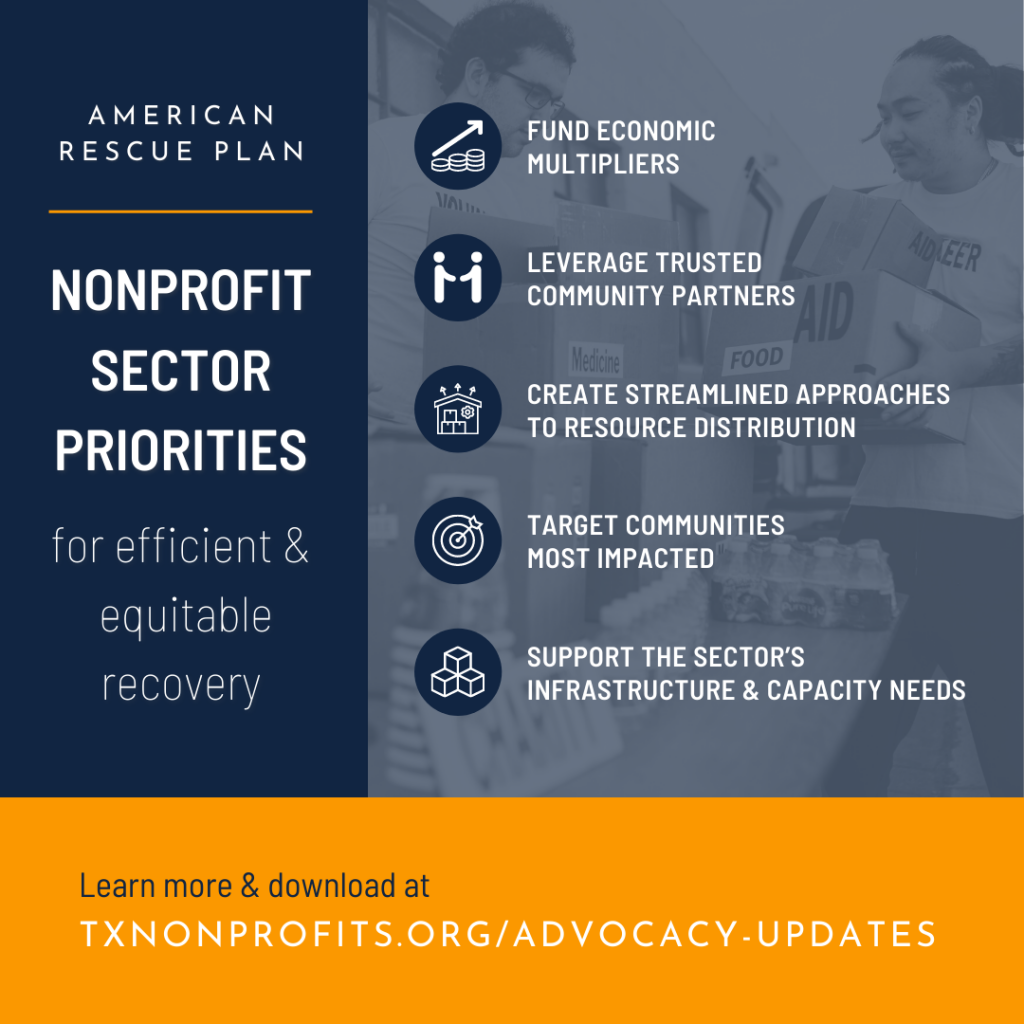
American Rescue Plan: Nonprofit Sector Priorities for efficient & equitable recovery

American Rescue Plan: Texas Nonprofit Sector Priorities for Efficient & Equitable Recovery

This post was written by Molly Weiner, United Ways of Texas Director of Nonprofit Engagement, and originally posted at txnonprofits.org/advocacy-updates.

Over the next month, Texas lawmakers will make critical decisions to spend $16.7 billion of American Rescue Plan Act funds to respond to the pandemic and support communities as they continue their recovery this fall. These recovery funds are intended to provide aid to “households, small businesses, and nonprofits” most affected by the pandemic. The inclusion of nonprofits as eligible recipients of these funds acknowledges both the critical role nonprofits have played during this pandemic and the struggles they have faced due to declining fundraising, changing operational strategies, and increasing public need for services. Nonprofits have remained resilient in these difficult times, anchoring communities and fulfilling their missions, often at great organizational cost.

State lawmakers have flexibility to spend American Rescue Plan dollars in a way that maximizes relief and supports the rebuilding of communities.  The nonprofit sector urges policymakers to consider these priorities when allocating relief dollars to maximize impact and spur the Texas recovery:

  • Fund economic multipliers
  • Leverage trusted community partners​​
  • Create streamlined approaches to resource distribution​
  • Target communities most impacted​
  • Support the sector’s infrastructure and capacity needs​

Texas nonprofits that have expressed support of these priorities include:

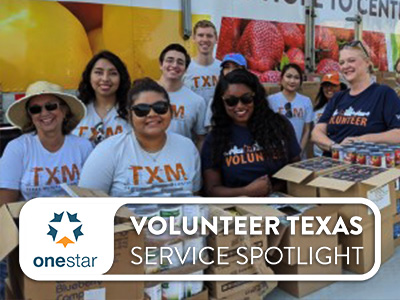
Texas insurance company builds a culture of service through employee involvement | Volunteer Texas Service Spotlight

Texas Mutual was a recipient of a 2020 Governor’s Volunteer Award. If you know an individual or organization making a significant impact in Texas communities through service and volunteering, you can nominate them for the 2021 Governor’s Volunteer Award here.

On a mission to build a stronger, safer Texas, Texas Mutual has a culture of service spurred by team members who are dedicated to making our state a better place to live and work.

“We are the largest provider of workers compensation insurance in the state of Texas. We have about 40% of the market, insure 70,000 businesses, and they employ about a million and a half workers. The overall strength and safety of Texas is really, really important to us,” said Jeremiah Bentley, Vice President of Marketing & Community Affairs at Texas Mutual.

In 2019, 473 Texas Mutual employees volunteered an impressive 5,300 hours for 103 nonprofit organizations across the state. The depth of Texas Mutual’s engagement can be seen in their longstanding partnership with the Central Texas Food Bank. In addition to providing nearly 550 hours of volunteer support to the organization, they also used their business expertise to revamp pantry distribution logistics and operations to better serve families in need.

When the COVID-19 pandemic struck last year, Texas Mutual remained committed to strengthening communities and found ways to continue serving safely. For example, the company purchased meals from local struggling restaurants and had them delivered to families at the Ronald McDonald House Charities. Employees also wrote letters of encouragement to dedicated 211 call center representatives and hosted virtual reading sessions with students to promote literacy.

“Sometimes you just have to get creative. If you’re not able to help one way, you can help in another way,” Jeremiah said.

Jeremiah shared with OneStar his approach to corporate volunteering and talked about the impact companies can have on the community.

How do you build a culture of service within your company?

Our tagline is that we’re looking to build a stronger, safer Texas. We do that through what we do everyday in our jobs, we do that through our philanthropy and grants, and then we also do that through volunteers. It has always been part of our culture to give back and to strengthen our communities. 

Look at yourself, look at your mission, and look at the causes that align with who you are and what you stand for. Look at the unique skills that you and your employees can bring to the table, and then talk to employees and see where they’re already engaged. A lot of times, you find that you’ve got a group of employees who are doing things that honestly already aligns with who you are and what we do. We had people working with the food bank for a long time before we figured out that beyond just these shifts, there was more that we could do. Ask people, and you’ll find that there’s probably something out there that makes sense for you as an organization.

What unique value does your company bring to volunteering?

We’ve got lots of activities we do, but where we can, we want to bring our unique abilities to bear in volunteerism. As an organization, you need to know your strengths, so we looked at what are the things that we that we can uniquely provide to help out a nonprofit? At first, we thought, “We’re all just spreadsheet jockeys一maybe we don’t have unique talent.” But we dug deeper and thought about the core of what we do in different parts of the company, and it became evident that we do have skills to contribute to these causes beyond working a shift.

The Greater Houston Partnership was developing communities of practice around workforce development—talking to companies first to find out what they need and developing programs around that. That’s the way we work at Texas Mutual: we look at our customers, center what we do, and develop products and services based on that. We’ve got a bunch of project managers who are really good at logistics, so we actually loaned out some of our project management people to them.

We did it on the marketing side too. We had a really strong relationship with Workforce Solutions Capital Area and developed a campaign called Trade Up Texas, which was about connecting 18- to 25-year-olds with job skills. How do you let young people know that you can make a lot of money in construction and plumbing and trades, and that it is a real career path with an opportunity to create wealth? We provided our services pro bono to help solve that problem as a marketing problem while also meeting a real community need.

What makes an effective corporate volunteer program?

The most important thing is to involve employees in designing the program. Don’t just pick your favorite charity and expect the kind of engagement you might have if you’d talked to people and listened to the voices of the folks who are actually doing the volunteering. Make sure that whatever you’re doing is something that they find meaningful.

We’ve got a volunteer committee in each office with different levels of employees who have their ear to the ground on what it is that people really want to do and how you engage people. It’s human behavior: people are going to buy in more if they feel involved in the process and feel like their voice is heard, so we work really hard to do that. Let’s talk to people about what they want, and how we can connect what they want to do to who we are and build our program that way. We have to facilitate that. It’s a fine line to provide some direction and guidance while still being encouraging.

What are the benefits of corporate volunteering?

The number one benefit that we get out of it is employee recruiting and retention. We’ve been really intentional about talking more about the things we’re doing in the community and talking about volunteerism. We’ve heard more applicants who say, “I know who you guys are because I saw on Facebook all the good work y’all are doing.” It helps us attract the types of employees who are committed to that. Italso helps give employees meaning to their work. If you’re a programmer or an accountant, you don’t see every day the results of your work in the way that someone who is actually out in the field interacting with clients does. Volunteering can help them do that. 

There’s also a developing consumer demand. There is a lot of research around younger buyers all the way across the board, from consumer products to business services, who want to buy from companies whose values align with theirs. People sometimes feel like it’s bragging to talk about it, but it’s really just letting the public know your story. The more you can let the public know who you are in an authentic way一who the people are and not necessarily just the brand一the better off you’ll be. There is a price premium people are willing to pay for companies that share their values, and I think it’s becoming more and more important and will continue to be over time. For us, it’s particularly important because we’re only in Texas, and we only sell work comp, so we want to be known as a company that’s here based in Texas taking care of all Texans across the board, because that’s how we’re all gonna succeed together.